
Overview
Drawing on my experience supporting faculty as a Digital Learning Teacher and now in higher education, I’ve continually sought ways to help educators adopt meaningful technology in their practice. This course deepened that motivation by encouraging me to design a professional learning program that centers on AI tools in education, with the goal of growing into the role of an Instructional Technologist.
For this project, I collaborated with Colleague AI to design a professional learning lesson plan focused on AI and course integration. I used the Backward Design framework (UbD) to guide the process, starting with the learning outcomes I wanted educators to walk away with.
The goal was to help educators better understand how to thoughtfully and ethically integrate AI tools into their teaching. I aligned the lesson with the ISTE Standards for Educators and UNESCO’s AI in Education framework, making sure the focus remained on both strong pedagogy and a human-centered approach to technology use.
Topic & Standards
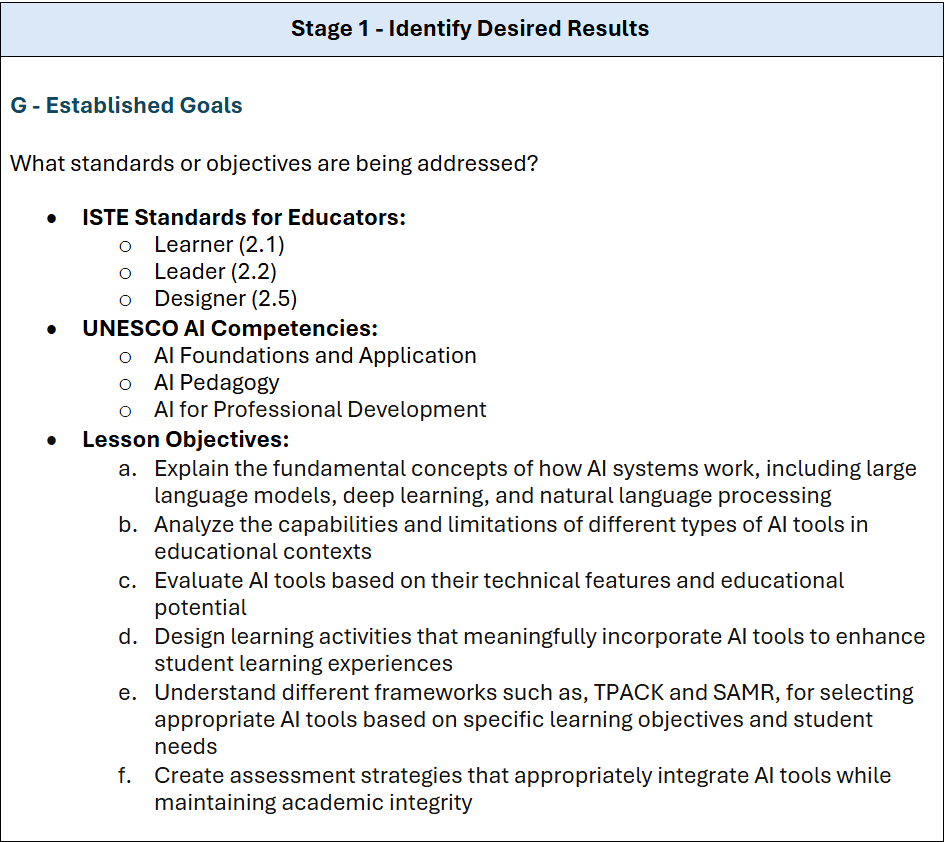
My design was grounded in the ISTE Standards for Educators—particularly:
- 2.1 Learner: Actively learning to improve practice and explore innovative applications of technology.
- 2.2 Leader: Advocating for equitable access and modeling lifelong learning.
- 2.5 Designer: Designing authentic, learner-driven experiences supported by technology.
I also integrated guidance from UNESCO’s AI in Education framework, particularly the domains of AI Foundations and Application, AI Pedagogy, and AI for Professional Development. These standards emphasized a human-centered, pedagogically grounded approach to integrating AI into learning environments.
Desired Results & Assessment
By the end of the program, educators should be able to:
- Understand the foundations of AI, including how AI and large language models (LLMs) work.
- Apply AI integration principles within lesson planning.
- Evaluate AI tools for pedagogical alignment using TPACK and SAMR frameworks.
- Maintain a human-centered approach that balances innovation with ethical responsibility.
To assess their learning, participants will:
- Build a professional portfolio with annotated lesson plans that demonstrate purposeful tool selection.
- Provide rationales for tool use that reflect pedagogy, content, and context.
- Submit documentation of tool use, including classroom impact, student engagement, and changes to instructional practice.
- Reflect weekly through journals and create a growth plan outlining future learning goals.
- Present their learning in Professional Learning Community (PLC) sessions to extend knowledge sharing.
Learning Plan & Tech Integration
The program spans 6 weeks, meeting three times per week, with each week scaffolding knowledge and hands-on experience:
- Week 1: Introduces AI literacy and integration frameworks like TPACK and SAMR.
- Week 2: Focuses on ChatGPT and LLMs, emphasizing prompt design and ethical classroom uses.
- Week 3: Guides lesson planning using Khanmigo, Gamma AI, and Colleague AI to explore AI-assisted content generation.
- Week 4–5: Participants choose an AI tool and implement it through both TPACK and SAMR lenses, receiving feedback along the way.
- Week 6: Final portfolios are submitted, and educators present key learnings through PLC presentations to model knowledge sharing.
Throughout, digital tools are not just explored—they are integrated into teaching design and evaluated based on their impact, relevance, and ethical use.
Reflection
This design process really made me appreciate how important it is to be intentional and structured when designing learning experiences, especially when working with evolving tools like AI. Using Colleague AI gave me a lot of creative possibilities, but at times I felt overwhelmed by the amount of choices. Next time, I would come in with more clarity, some specific goals or constraints, to help guide the brainstorming and keep things focused.
One thing that worked really well was the way the lesson built from foundational concepts into practical application. It helped me think more about how to scaffold learning in a way that is both meaningful and flexible. I also saw just how valuable it is to include reflection and peer sharing in professional learning, as it is what helps ideas stick and gives educators space to grow together.
Overall, this project made me feel more prepared and confident as I move toward a future in instructional technology. It took more planning than some of the work I have done before, but it also confirmed that this is the kind of work I want to keep doing—supporting educators in using technology thoughtfully, ethically, and with real impact. It reminded me that digital leadership is not just about the tools. It is about helping others design lasting, transformative learning experiences.
Presentation
Select to view the slide deck.

Lesson Plan