
With the rapid advancement of digital tools and AI technologies, educators and instructional designers now have more powerful resources than ever to collect, analyze, and act on learning data with precision and speed.
For instructional designers, this opens up new possibilities for understanding how learners engage with content and how courses can be improved. In a previous article, I explored MOOCs and online learning, highlighting how instructional design might help address low completion rates. But as Loizzo (2015) notes, completion rates alone may not offer the clearest picture of learner success, especially when students have varying motivations and goals. So if completion rates aren’t the most useful metric on their own, what data points should instructional designers be paying attention to? And how can AI support instruction designers in identifying and applying that data meaningfully?
AI tools are reshaping instructional design by streamlining data analysis and enabling more personalized, scalable, and informed course development. When applied thoughtfully, AI can uncover patterns that might otherwise go unnoticed, support data-driven decision-making, and enhance learning outcomes. At the same time, these opportunities come with important challenges, including concerns around ethics, bias, and ensuring that implementation remains grounded in human-centered and intentional design.
The Intersection of AI, Data, and Instructional Design
Educational Data Mining and Learning Analytics
Educational data mining (EDM) and learning analytics (LA) give instructional designers deeper insight into student engagement and success. Completion rates alone don’t reflect the full picture. By examining factors like course activity, demographic trends, feedback, and content usage, Designers can better understand learner behavior and identify which students are at-risk and where support is most needed (West et al., 2018).
For more evidence of valuable data points, institutions like the University of Phoenix collect and combine a wide range of information, including grades, discussion posts, tech support tickets, and application records (West et al., 2018). Integrating these data sources enables the creation of predictive models that support student persistence and guide course improvements.
To manage this scale of data, distillation processes are used to reduce larger datasets into more manageable forms, while maintaining key patterns (Kang et al., 2024). Once data has been distilled, various analytical techniques in EDM/LA can be applied. These techniques are typically categorized into three core methods. Table 1 summarizes these methods as outlined by West et al. (2018).
Table 1: Overview of Educational Data Mining & Learning Analytics Methods (West et al., 2018)
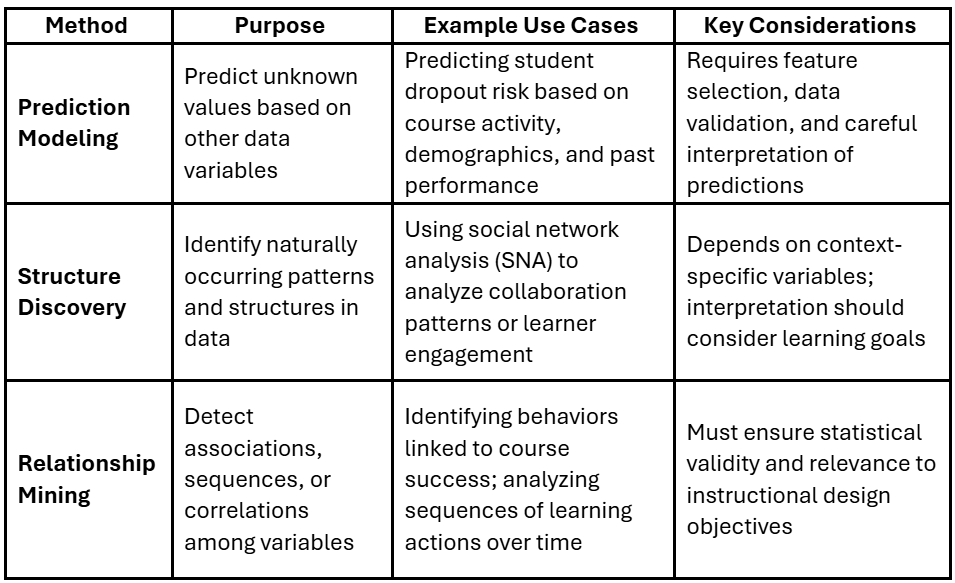
These methods help instructional designers move beyond surface-level metrics and toward deeper insights that directly inform course development and student support strategies. However, they can be time-consuming and costly to implement—creating opportunities for AI to enhance and streamline the process.
How AI Enables Data-Informed Decision Making (DIDM)
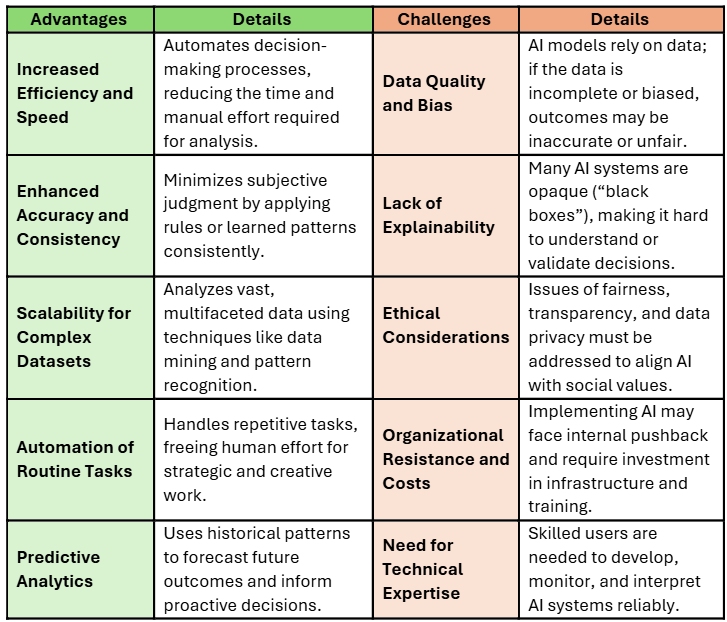
AI plays an increasingly central role in data-informed decision making (DIDM) by enabling faster, more accurate, and scalable analysis of large datasets. These technologies can streamline workflows, improve predictions, and uncover patterns that might otherwise go unnoticed. However, they also introduce new challenges related to bias, explainability, and implementation barriers. As instructional designers adopt AI, it’s essential to weigh both the benefits and limitations to ensure responsible and ethical use. Table 2 highlights these advantages and challenges, based on Balbaa and Abdurashidova’s (2024) research.
Table 2: Advantages and Challenges of AI in Decision Making (Balbaa & Abdurashidova, 2024)
AI’s Impact on Instructional Design Roles and Practices
Ethical Use of AI in Instructional Design
As AI tools become more embedded in instructional design practices, it’s critical to consider their ethical use. UNESCO emphasizes a handful of guiding principles that should shape how designers adopt AI. These include transparency, equity, respect for human autonomy, prevention of harm, responsibility, and strong data governance (Miao & Cukurova, 2024). These values are particularly important when dealing with sensitive student data and designing learning environments that aim to support all learners.
One major concern is algorithmic bias, which happens when the data used to train AI systems contains historical or societal biases (Balbaa & Abdurashidova, 2024). This can lead to unfair or inaccurate outcomes, particularly for marginalized groups. For example, if training data focuses too heavily toward one demographic, AI-generated recommendations or decisions may unintentionally exclude others.
Privacy is another key issue. While longitudinal data can offer powerful insights into learning patterns and outcomes over time, gathering that much personal information also raises important ethical and legal concerns. Instructional designers must balance the benefits of data-driven insight with the need to follow data protection laws and respect learners’ digital rights (West et al., 2018).
Finally, many AI models operate like “black boxes,” meaning it’s not always clear how they’re making decisions (Balbaa & Abdurashidova, 2024). This lack of transparency can make it tough to build trust in the tools we’re using—and even harder to explain or defend their outcomes.
Human-AI Collaboration in Design Work
Another key principle in UNESCO’s AI compliance guidelines is the importance of taking a human-centered approach when integrating AI (Miao & Cukurova, 2024). In instructional design, this perspective helps ensure that AI tools support ethical responsibility and meaningful learning outcomes. While AI can analyze large datasets and surface patterns rapidly, it lacks the contextual awareness, empathy, and critical thinking that human designers provide. Keeping humans in the loop leads to learning experiences that are not only efficient, but also inclusive, pedagogically sound, and aligned with learner needs.
With human oversight in mind, a structured review process helps uphold both quality and ethical standards. For example, when designing AI-assisted simulations for a health sciences course, a designer might:
- Review for factual accuracy and relevance
- Review for alignment with pedagogical goals and cognitive load
- Review for inclusive language, tone, and accessibility
This iterative process reflects UNESCO’s emphasis on human-centered AI—where technology supports and enhances human decision-making, promoting efficiency, quality, and accuracy.
For more on this collaborative framework, see my article on the HAIH model (Human-AI-Human), which outlines practical strategies for integrating AI thoughtfully throughout any design process such as goal setting.
AI in Automating Routine Tasks
AI’s most immediate impact on instructional design is in automating repetitive or time-intensive tasks, giving designers more space for creative and strategic thinking (Ch’ng, 2023). Tasks like aligning learning objectives, organizing course content, or drafting initial assessment items can now be accelerated with AI tools.
When applied to the ADDIE model, AI plays a role across each phase:
Analysis
Traditionally, the analysis phase required significant time and effort, involving manual data collection through interviews, surveys, and reviewing historical learner data to develop accurate learner profiles (Ch’ng, 2023). AI changes this by streamlining data collection and interpretation. It can analyze complex datasets like LMS logs, survey responses, and performance trends much faster than a human could. This results in more accurate insights and reduces the burden on instructional designers.
Design & Development
AI tools enable designers to create text, images, audio, and video content quickly, even without deep technical skills. Voiceovers and auto-captioning make audio production more accessible, while visual and textual content can be generated on demand. The result is richer, more inclusive multimedia content created with less time and effort.
Implementation
AI-powered chatbots and asynchronous tools are becoming increasingly common in today’s courses. They provide learners with real-time feedback and support, which is especially valuable in online self-paced environments. Intelligent Tutoring Systems (ITS) take this further by personalizing instruction, helping learners navigate challenging concepts at their own pace and offering tailored guidance (Gibson, 2023).
Evaluation
AI supports both formative and summative assessment by offering features like automated grading, real-time feedback, and predictive modeling to identify at-risk students (Gibson, 2023). This enables instructors to intervene earlier and make adjustments as needed. Additionally, AI helps reveal patterns in learner behavior that can guide improvements in future course design
Reframing Instructional Design Work
As AI reduces the manual workload in areas like analysis and development, instructional designers have more space to focus on what really matters like improving the learner’s experience, advancing inclusive design, and thinking strategically. But to make the most of these tools, designers need access to professional learning environments that encourage exploration and build confidence. Without that support, it’s easy to miss out on the full potential of AI, and designers may hesitate to experiment or integrate it meaningfully into their practice.
Effective AI Tools and Strategies for Course Development
Overview of Instructional Design AI Tools
As AI becomes more integrated into educational technology, instructional designers have access to a growing suite of tools to support their work. Popular platforms like ChatGPT, Gemini, Claude, and Copilot are widely used because they’re easy to access, intuitive, and generally reliable for tasks like brainstorming, summarizing content, or drafting outlines. However, because these models are trained on broad and diverse datasets, they can sometimes generate “hallucinated” or inaccurate information that lacks context for instructional design.
For more targeted support, specialized AI tools designed for specific subjects, like education, offer greater value. These tools are often trained on instructional design principles and pedagogical frameworks, giving them a deeper understanding of concepts like learning progressions, cognitive load theory, instructional alignment, and scaffolding (Hardman, 2025). When integrated thoughtfully, they can help create more pedagogically sound learning experiences that are better aligned with course objectives and learner needs.
Supporting the Analyze Phase
AI can enhance traditional methods like surveys and interviews by streamlining and improving how data is gathered and interpreted:
- SurveyMonkey – Helps instructors quickly create, distribute, and analyze surveys, gathering insights on learner needs and institutional goals (Hardman, 2024).
- Descript or Fathom – Automatically transcribe and analyze recorded interviews or stakeholder meetings, making it easier to extract meaningful trends (Hardman, 2024).
- Notebook LM – Allows users to upload documents and generate summaries or insights based strictly on their own data, providing a secure and focused environment for needs assessments.
Note on Privacy: As outlined in the UNESCO Guidelines for AI Competency, it’s important to protect student and institutional data. Designers should avoid inputting confidential student or institutional information into public models.
Tools like Microsoft Copilot with Enterprise Data Protection (EDP) offer added safeguards, ensuring that prompts and responses aren’t stored or used to train models (DHB-MSFT, 2025).
Supporting Other ADDIE Phases
AI can also be used across other stages of the ADDIE model, such as the design and development stages. For example:
- Jasper – Assists with writing content that matches tone, clarity, and learning outcomes.
- Khanmigo and Colleague AI– Offers AI-powered tutoring, lesson planning, and scaffolding specifically designed for educational settings.
The infographic below, curated by Dr. Philippa Hardman, outlines additional tools and shows how they align with each stage of the ADDIE model—offering a strategic and responsible approach to integrating AI into course development.

Best Practices and Practical Applications
As with any instructional design tool, using AI effectively requires intentionality and thoughtful application. Simply inputting a question or request will not always result in high-quality or relevant output. To get the most from generative AI, it’s important to understand how to craft prompts and how to refine the content AI produces.
AI Prompting
Well-structured prompts lead to better, more focused results. When writing prompts for AI, instructional designers should aim to include specific information such as the task’s purpose, intended audience, content type, format, and tone (NC State University, 2025). This helps the AI generate responses that are more aligned with the instructional goals. For instance, prompting AI to “generate a quiz for adult learners on Bloom’s Taxonomy” will yield more useful results than simply asking it to “make a quiz.”
Use the prompt design table below, created by North Carolina State University, as a guide for crafting clear and detailed prompts that help AI generate accurate, well-structured, and relevant responses.

Refining Generated Content
Whether using general tools like ChatGPT or specialized platforms like Khanmigo, it’s important to remember to approach AI as a support tool and not the final authority.
Instructional designers should always refine AI-generated content to:
- Align with learning objectives
- Simplify language for clarity and accessibility
- Verify facts and correct errors
- Match the tone and format to the course context
AI should enhance, not replace, human judgment. Thoughtful review ensures content remains accurate, pedagogically sound, and centered on the learner.
Conclusion
AI holds tremendous promise for transforming instructional design by enhancing data analysis, enabling personalized learning, and automating routine tasks. When paired with ethical practices and strong human oversight, AI can help educators meet the demands of personalized learning and improve data-driven decision-making. The responsible integration of AI requires ongoing attention to transparency, equity, and privacy to ensure its benefits are accessible to all learners without unintended harm.
Moving forward, the challenge is not whether to adopt AI, but how to adopt it wisely and equitably to ensure meaningful learning for all students. By embracing a human-centered approach that leverages frameworks like ADDIE and tools like Khanmigo, instructional designers can harness AI’s potential to create more effective, inclusive, and impactful educational experiences. To achieve this, instructional designers should advocate for professional development programs, such as workshops on ethical AI use or certifications in learning analytics, to build their AI literacy and confidence. With the right tools and training, instructional designers can lead the charge in creating innovative, equitable learning environments that empower all students.
References
Balbaa, M., & Abdurashidova, M. (2024). The Impact of Artificial Intelligence in Decision Making: A Comprehensive Review. ResearchGate. https://doi.org/10.36713/epra15747
Ch’ng, L. K. (2023). How AI Makes its Mark on Instructional Design.
DHB-MSFT. (2025, May). Data, Privacy, and Security for Microsoft 365 Copilot. https://learn.microsoft.com/en-us/copilot/microsoft-365/microsoft-365-copilot-privacy
Gibson, R. (2023, August 14). 10 Ways Artificial Intelligence I s Transforming Instructional Design. EDUCAUSE Review. https://er.educause.edu/articles/2023/8/10-ways-artificial-intelligence-is-transforming-instructional-design
Hardman, D. P. (2024, September 11). The Most Popular AI Tools for Instructional Design (September, 2024) [Substack newsletter]. Dr Phil’s Newsletter, Powered by DOMSTM️ AI. https://drphilippahardman.substack.com/p/the-most-popular-ai-tools-for-instructional
Hardman, D. P. (2025, January 16). Scaling Evidence-based Instructional Design Expertise Using AI [Substack newsletter]. Dr Phil’s Newsletter, Powered by DOMSTM️ AI. https://drphilippahardman.substack.com/p/scaling-evidence-based-instructional
Kang, I., Ram, P., Zhou, Y., Samulowitz, H., & Seneviratne, O. (2024). Effective data distillation for tabular datasets (student abstract). Proceedings of the Thirty-Eighth AAAI Conference on Artificial Intelligence and Thirty-Sixth Conference on Innovative Applications of Artificial Intelligence and Fourteenth Symposium on Educational Advances in Artificial Intelligence, 38, 23533–23534. https://doi.org/10.1609/aaai.v38i21.30460
Loizzo, J. L. (2015). Adult learners’ perceptions of MOOC motivation, success, and completion: A virtual ethnographic study. Theses and Dissertations Available from ProQuest, 1–300.
Miao, F., & Cukurova, M. (2024). AI competency framework for teachers—UNESCO Digital Library. UNESCO. https://unesdoc.unesco.org/ark:/48223/pf0000391104
NC State University. (2025). Using AI to Assist With Course Design – Teaching Resources. https://teaching-resources.delta.ncsu.edu/ai-course-design/
West, R. E. et al. (2018). Foundations of Learning and Instructional Design Technology. https://edtechbooks.s3.us-west-2.amazonaws.com/pdfs/3/_3.pdf