

Massive Open Online Courses (MOOCs) have opened the door to education for millions of learners around the world. Originally developed to provide free and flexible learning for those without access to traditional classrooms, MOOCs have become a widely used resource, offering courses on nearly any subject or certification. While the idea of making education more accessible is exciting, MOOCs still face real challenges. Completion rates are low, engagement is inconsistent, and learners often drop off before reaching their goals.
These challenges highlight the importance of instructional design in shaping more effective and supportive online learning environments. Looking at both the strengths of MOOCs and the difficulties learners encounter, points to clear opportunities for applying appropriate design strategies informed by motivation theory. When course structures are intentionally aligned with learners’ needs and goals, MOOCs can move beyond simple accessibility and serve as more reliable pathways to meaningful and lasting learning outcomes.
The Benefits of MOOCs
MOOCs provide flexible and affordable learning opportunities, opening doors to self-development and competency-building beyond formal educational settings (Müller et al., 2024). By removing barriers like cost, location, and entry requirements, they open valuable opportunities for a broader range of learners.
As mentioned, one of the primary advantages of MOOCs is their affordability. Most MOOCs are either free or available at a relatively low cost, allowing learners to engage with high-quality content without the financial strain of tuition-based programs. Many MOOC platforms are open-source and designed to scale, which means they can support thousands of learners at the same time without limiting who can participate (West et al., 2018).
MOOCs also provide a unique blend of flexibility and structure through synchronous and asynchronous learning formats (West et al., 2018). Asynchronous courses allow learners to engage with content on their own time, which makes it easier to fit learning around work, family, or other responsibilities. Synchronous courses, on the other hand, include live sessions that bring people together in real time and help build a sense of community. This combination supports a variety of learning styles and makes it easier to design experiences that meet learners where they are.
Another key benefit of MOOCs is their potential to cultivate a sense of belonging and connection within a digital learning community (West et al., 2018). While the large-scale nature of MOOCs might seem impersonal, a handful of platforms include forums, peer feedback, and group activities that encourage collaboration and social interaction.
Despite these advantages, MOOCs face a persistent challenge of having notoriously low completion rates. Research shows that fewer than 15% of enrolled learners typically finish their courses (Loizzo, 2015). This issue raises important questions about learner engagement and the overall effectiveness of MOOCs, setting the stage for exploring how instructional design can make a meaningful difference.
The Role of Instructional Design in Improving MOOCs
Low completion rates in MOOCs are often linked to factors like course length, learner motivation, and engagement strategies (Jordan, 2015). However, these numbers don’t tell the whole story. Many learners enroll with different goals in mind. Some join to refresh prior knowledge or explore new topics without aiming for a certificate, which can lead to less consistent participation or course completion (Zhu et al., 2022). Still, improving course design to better support diverse learners and sustain motivation is essential to helping more participants reach their goals. Thoughtful instructional design offers strategies that enhance engagement, build community, and ultimately support higher completion rates in MOOCs.
Motivation and The Self-Determination Theory
Understanding what motivates learners is a key part of designing effective MOOCs. While most learners enter a course with the intention of completing it, motivation can waver due to factors like loss of interest, lack of prior knowledge, or difficulty managing time and staying self-directed (Zhu et al., 2022).
Motivation is often categorized as either intrinsic or extrinsic. Intrinsic motivation stems from personal interest or curiosity, learners who simply want to expand their knowledge or dive into a subject they enjoy (Zhu et al., 2022). Extrinsic motivation, on the other hand, is more outcome-driven and tied to goals like earning a credential, gaining a job skill, or fulfilling a professional requirement.
Both types of motivation tie into Self-Determination Theory (SDT), which emphasizes three basic psychological needs: autonomy, competence, and relatedness (Jain & Roy, 2024). When these needs are met, learners tend to feel more motivated and engaged performing tasks that they may not have a strong desire or interest in. However, the learner understands that the task may be necessary for more desirable outcomes.
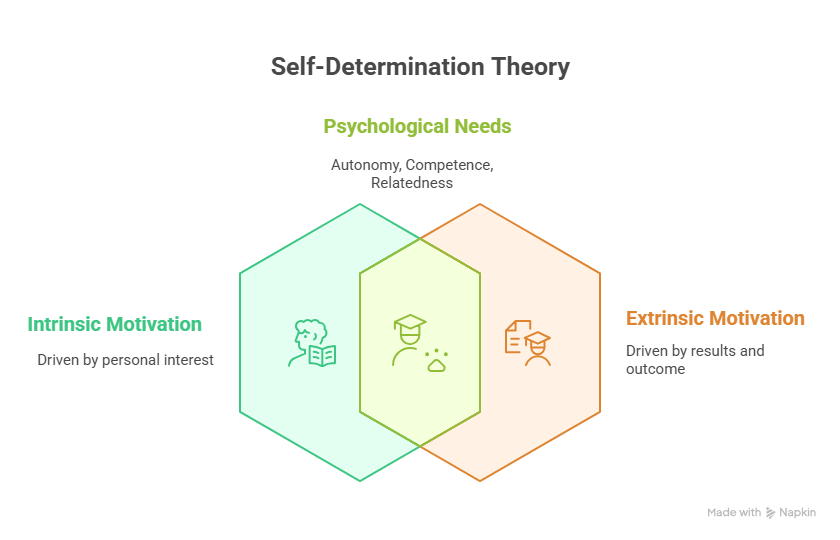
To break SDT down a bit more, intrinsic motivation tends to grow when a course helps learners feel in control, capable, and connected—even in a virtual space (West et al., 2018). And while intrinsic motivation can be a strong driver, many MOOCs still rely on extrinsic motivators, especially when learners enroll with goals like career advancement or earning academic credit.
That said, not all extrinsic motivation is the same. Integrated regulation is a form of extrinsic motivation that has proven to be the most effective. Integrated regulation is where a learner understands the importance of a course and connects it to their identity or long-term goals (West et al., 2018). Therefore, even if the course itself isn’t particularly enjoyable and if the learner sees it as important for their future, the student is much more likely to follow through and complete it.
From a design perspective, supporting both intrinsic and extrinsic motivation is essential. This starts with clearly communicating course objectives and pacing at the very beginning. When learners know what to expect and how to plan their time, they’re more likely to stay committed. Research suggests that providing a roadmap, offering time-management tips, and helping learners anticipate the course pace can boost follow-through and reduce drop-off (Zhu et al., 2022).
For instance, organizing objectives into smaller, manageable chunks and incorporating regular check-ins or assessments can help build momentum (Rogers-Estable et al., 2015). These design choices support competence and provide a sense of progress, which can be motivating on its own.
Active Learning and Human Connection
While designing for motivation lays the foundation for learner engagement, maintaining that engagement throughout the course requires more than just clear goals and pacing. Learners also need to feel connected to the content and the learning community. This is where active learning strategies and human connection play a crucial role. By making the learning experience more interactive and socially supportive, MOOCs can not only reinforce motivation but also deepen understanding and increase retention.
Active learning emphasizes the importance of engaging with content in meaningful ways rather than passively consuming information. Research shows that simply watching videos or reading text rarely leads to deep learning or long-term skill development (Müller et al., 2024). Instead, retention improves when learners are asked to apply what they’re learning through activities such as problem-solving, discussions, and collaborative projects. These kinds of activities push students to reflect on the material and connect it to real-world situations, which helps build a deeper sense of competence. For more background on this topic, you can refer to my earlier article on active learning and learning theory.
Social interaction is another important aspect of active learning. Drawing on Vygotsky’s theory of the Zone of Proximal Development (ZPD), learners tend to make the most progress when supported by others—especially peers or instructors who can guide them just beyond their current level of understanding (West et al., 2018). Learning in a community allows learners to exchange ideas, receive feedback, and challenge their thinking, which can help deepen comprehension and improve motivation.
However, the asynchronous nature of many MOOCs can create a sense of isolation. Transactional Distance Theory explains that when learners feel psychologically distant from their instructor or peers, they may become disengaged or discouraged (West et al., 2018). To reduce this distance, course designers can implement strategies that promote regular communication and interaction. For example, scheduled live sessions, walkthrough videos, and personalized messages can simulate a more human presence in the course.
Discussion forums also serve as a valuable space for connection and reflection. When used intentionally, they can create accountability, spark thoughtful conversations, and cultivate a sense of community. Instructors or facilitators can encourage participation by posing open-ended questions, acknowledging responses, and sharing model answers after learners have submitted their own. Even automated instructor feedback on assessments can make a course feel more responsive and supportive for the learner.
Human connection can also be encouraged by offering networking opportunities, such as prompting learners to form Personal Learning Networks (PLNs) or encouraging them to connect on external platforms. When learners feel they’re part of a broader learning community—whether through peer support, instructor presence, or collaborative tasks—they’re more likely to stay engaged and persist through challenges, further supporting and encouraging their self-determination.
User Experience Design
Even with strong content and engaging activities, poor design can quickly derail a learner’s progress. When a course interface is confusing or unintuitive, learners must spend time figuring out how to navigate rather than focusing on the material. These friction points often stem from design flaws that create unnecessary barriers to learning (West et al., 2018).
Applying principles of User Experience (UX) and Human-Computer Interaction (HCI) helps prevent these issues. A user-centered design (UCD) approach ensures that learners’ needs, behaviors, and expectations are prioritized throughout the design process (West et al., 2018). This can be implemented and considered when designing with an Instructional Design Model, which will be explored further in this article. Clean layouts, consistent navigation, and accessible features reduce cognitive load and help learners stay focused.
For example, consistent navigation menus, readable fonts, and clearly labeled buttons contribute to a smoother learning experience. Intuitive layouts and minimal distractions help learners stay on task. Even small decisions, such as how feedback is displayed, how long pages take to load, or whether course modules are visually grouped in logical sequences, can either enhance or interrupt the flow of learning.
Gamification and the Role of Play in Learning
As MOOCs continue to evolve, gamification seems like an effective strategy to keep learners motivated and engaged. Gamification is defined as the application of game design elements in non-game contexts (West et al., 2018). In educational settings, gamification has been shown to boost motivation, increase engagement, and support content retention (West et al., 2018).
Incorporating elements like digital badges, progress tracking, and certification milestones can help learners visualize their growth and celebrate achievements along the way. These reward systems tap into learners’ intrinsic and extrinsic motivations, encouraging them to persist through challenging material. For example, earning a badge for completing a module or receiving a certificate upon course completion can reinforce a sense of accomplishment and purpose.
Research also suggests that among game-based learning formats, games may offer greater learning gains compared to virtual worlds or simulations (West et al., 2018). However, the success of any delivery method ultimately depends on how well it aligns with the instructional goals and learner context (West et al., 2018). Effective instructional design ensures that game elements are not just decorative but serve a pedagogical purpose, guiding learners through meaningful challenges that reinforce learning objectives.
By thoughtfully integrating gamification into MOOCs, designers can enhance both the motivational and instructional quality of the course. When used strategically, these elements support learner autonomy, competence, and relatedness—all key factors in improving learner outcomes and course completion rates.
Instructional Design Models
With motivation, engagement, and user experience strategies in place, the next step is to consider how to structure the overall learning experience. Selecting an appropriate instructional design (ID) model is essential to align course objectives, delivery formats, and learner needs. The choice of model often depends on key factors such as whether the course will be synchronous, asynchronous, or a blend of both, as well as the specific context and goals of the MOOC (West et al., 2018).
Understanding the course context, such as the subject matter, the target audience and their background knowledge, and the types of materials that make the most sense, is essential for designing an effective learning experience. Frameworks like TPACK and the Backward Design process can help identify which resources and digital tools align best with the course objectives and delivery format. For more context, I explore the TPACK model in more detail in a previous article.
Guiding Principles
Establishing clear guiding principles upfront also further ensures the course design remains grounded in sound research and tailored to learners’ needs. For example, a MOOC focused on health behaviors might emphasize principles that support behavior change through interactive, learner-centered activities. These principles will be essential when developing MOOCs using any of the ID models discussed. The example below highlights guiding principles for this specific use case.

The ADDIE Model
The ADDIE model offers a progressive, foundational framework for instructional design. It’s often seen as the overarching structure under which more specific models operate (West et al., 2018). What makes ADDIE particularly useful for MOOCs is its adaptability and its emphasis on thoughtful planning and evaluation at each phase of course development.

- Analyze
The first step is all about understanding the problem and identifying the performance gap (West et al., 2018). In the context of MOOCs, this means taking time to analyze the course topic, audience, and learning goals. A user-centered approach (UCD) can be especially helpful here by using tools like personas, user stories, and learner motivation mapping to clarify who your learners are and what they need (West et al., 2018). This is also where guiding principles can be defined, helping shape decisions around platform choice (e.g., Coursera, Udemy, or an institutional LMS) and ensuring the course meets learner expectations.
- Design
Once the course goals and audience are clear, the next step involves planning how learning will happen. During the design phase, prototyping tools and wireframing can support early ideation around content structure and user flow. Designers should verify learning outcomes, map them to assessments, and build a plan for content delivery that suits the learning format—whether it’s synchronous, asynchronous, or hybrid (West et al., 2018).
- Develop
This phase is where the course starts coming to life. Instructional materials, videos, assessments, and interactive elements are created and refined. Tools like Articulate 360, Adobe Captivate, and Elucidat can support the development of engaging, accessible content tailored to diverse learners.
- Implement
In the implementation phase, the course is launched and delivered to learners. This involves preparing the learning environment, onboarding students, and ensuring the platform is functioning as intended. Facilitators may also play a role in supporting learners during this phase, particularly in moderated or semi-synchronous MOOCs.
- Evaluate
Finally, while evaluation takes place throughout the design process, it becomes more formal in this final stage. This includes gathering formative feedback during development, analyzing collected data, and assessing the quality of instructional processes after the course launch (West et al., 2018). Importantly, this phase should consider learner feedback, platform analytics, and learner engagement data to measure what’s working and what isn’t.
Some researchers argue that because MOOCs are meant to attract a diverse and potentially unlimited number of learners, this challenges the ADDIE model’s emphasis on analyzing learners and their contexts at the start of the design process (Müller et al., 2024). For example, it may be unrealistic to expect that badges will engage all learners effectively, given that many MOOC participants focus only on select topics instead of the entire course. Based on this, some suggest that ADDIE may not be the ideal model for MOOC design and development.
While I understand the basis for this argument, I believe the analysis phase can still be highly effective when it includes a deep understanding of learner motivations and a clear definition of the target audience and their intentions for the course. Gathering this information and tailoring strategies to fit the MOOC context can significantly increase learner engagement and completion rates.
That’s why establishing clear guiding principles early in the design process is so important as it ensures the course remains focused and meaningful for the people it’s designed to serve.
The Successive Approximation Model (SAM)
SAM is a simplified, agile version of ADDIE with three iterative phases: Evaluate, Design, and Develop (Rogers-Estable et al., 2015). Its focus on real-time feedback allows for a more flexible and responsive course design process, which is especially helpful in dynamic environments like MOOCs.

- Evaluate
This phase centers on understanding the course context and learner needs. Key questions include:
- Who is the target audience?
- What are their goals and tech skills?
- What learning format will be used?
- Are prerequisites or tutorials needed?
- How will learning be assessed?
- Design
This phase involves planning course structure, storyboarding videos, outlining assessments, and organizing content. Like ADDIE, it ensures alignment with learning goals, but allows more flexibility for change as feedback comes in (Rogers-Estable et al., 2015).
- Develop
Designs are built, tested, and refined. Because of its iterative nature, SAM supports continuous improvement as new learner feedback and needs emerge.
While SAM faces similar challenges as ADDIE when it comes to MOOCs, particularly the difficulty of precisely analyzing such a broad audience, it offers unique advantages. Its agile framework makes it more efficient to make adjustments as new learner needs emerge, which is especially valuable in open-enrollment environments.
Additionally, SAM is most effective when used alongside the backward design model (UbD) (Rogers-Estable et al., 2015). Like backward design, SAM is encouraged to start with clear, measurable course outcomes and designing everything else—activities, content, tools—to align with those end goals. This ensures that each element of the course serves a specific purpose and contributes to the intended learning experience.
By applying guiding principles, SAM begins by identifying the desired competencies and course outcomes, then works backward to ensure all content and assessments are aligned with those goals.
Conclusion
MOOCs have undeniably transformed access to education, providing unprecedented opportunities for learners worldwide. However, the persistent challenges of low completion rates and uneven engagement highlight that accessibility alone is not enough to ensure meaningful learning. As demonstrated, the key to unlocking the full potential of MOOCs lies in thoughtful instructional design—one that intentionally integrates motivation theory, active learning, human connection, user experience, and gamification.
By addressing learners’ psychological needs for autonomy, competence, and relatedness, and by creating interactive, community-oriented environments, MOOCs can provide deeper engagement and sustained motivation. Additionally, applying user-centered design (UCD) principles ensures that learners can focus on the content without unnecessary obstacles, while gamification adds an element of play and achievement that supports persistence.
Finally, adopting flexible, research-based instructional design models like ADDIE offers a structured framework for developing MOOCs that align with diverse learner goals and contexts. However, given the dynamic nature of MOOCs and their potentially unlimited enrollment, it’s essential to establish guiding principles before analyzing and gathering context within any design model. When these elements come together, MOOCs can transform from simple open-access platforms into dynamic, supportive, and effective learning experiences—expanding educational reach while helping learners achieve their personal and professional goals.
References
Jain, B., & Roy, S. kumar. (2024). Student Motivation in Online Learning. ResearchGate. https://doi.org/10.48047/INTJECSE/V14I1.540
Jordan, K. (2015). Massive open online course completion rates revisited: Assessment, length and attrition. The International Review of Research in Open and Distributed Learning, 16(3). https://doi.org/10.19173/irrodl.v16i3.2112
Loizzo, J. L. (2015). Adult learners’ perceptions of MOOC motivation, success, and completion: A virtual ethnographic study. Theses and Dissertations Available from ProQuest, 1–300.
Müller, A. M., Tan, C., Goh, C., & Lim, R. B. T. (2024). The Design of a MOOC on Health Behaviors: A Practical Blueprint for the Instructional Design of MOOCs. Qeios. https://doi.org/10.32388/6XQZ6F
Rogers-Estable, M., Cavanaugh, C., Simonson, M., Finucane, T., & McIntosh, A. (2015, August 12). 4. Instructional Design Principles | Virtual Learning Design and Delivery. https://courses.lumenlearning.com/virtuallearningdesigndelivery/chapter/4-instructional-design-principles/#chapter-30-section-3
West, R. E. et al. (2018). Foundations of Learning and Instructional Design Technology. https://edtechbooks.s3.us-west-2.amazonaws.com/pdfs/3/_3.pdf
Zhu, M., Bonk, C. J., & Berri, S. (2022). Fostering self-directed learning in MOOCs: Motivation, learning strategies, and instruction. Online Learning, 26(1), Article 1. https://doi.org/10.24059/olj.v26i1.2629


