
Data and Logic: Equipping Students to Solve Problems and Optimize Processes 

In an era where technology shapes businesses and schools, data analysis and computational thinking aren’t just for Data Scientists and Software Engineers—they’re vital for nearly every profession. These skills empower students to solve problems systematically, make informed decisions, and fuel innovation in business and education. By breaking down complex challenges, recognizing patterns, and using data to guide actions, students build a toolkit for success. For example, visualizing trends with bar graphs or streamlining processes through algorithmic thinking creates smarter, more efficient solutions. Mastering these skills enhances learning, transforms business processes, and can be taught effectively, preparing students to continue to shape and adapt to a tech-driven future. 

What Are These Skills? 

Data Analysis 

Data analysis is a foundational skill for building strong data literacy, enabling individuals to examine datasets and uncover meaningful insights. This process involves identifying patterns, trends, and relationships using statistical techniques and tools, transforming raw numbers into actionable knowledge (Data Literacy in STEM | TEA, 2023). Interpreting data is essential for making informed, data-driven decisions, and visual representations like graphs play a critical role in this process. The choice of representation shapes students’ analytical abilities, with distinct tools suited to different types of data. 

For example, bar graphs excel at displaying categorical data, where the order of points doesn’t matter. They are particularly effective for comparing discrete categories to highlight relative quantities at a glance (Rogers, n.d.). An example of this could be comparing sales across product lines or customer preferences. By working with bar graphs, students sharpen their ability to compare and contrast, a skill valuable for overall decision-making. In contrast, scatter plots are ideal for continuous data, where the sequence of results matters. They reveal relationships between variables, showing whether one predicts another or if they vary independently (Rogers, n.d.). This makes scatter plots powerful for spotting trends and correlations, skills essential for predictive analysis and understanding complex business data, such as forecasting inventory need or customer behavior. 

Computational Thinking 

Computational thinking is a problem-solving process that breaks complex challenges into smaller, manageable parts, devising systematic solutions similar to how a computer operates (Franchitti et al., 2024). It acts as a bridge between a problem and its resolution, relying on predetermined steps—or algorithms—to achieve a goal. Much like coding for a machine, this approach empowers students to craft solutions that are clear to both humans and computers, promoting effective problem-solving (Franchitti et al., 2024). 

Despite its name, computational thinking extends beyond technology, serving as a versatile framework across disciplines. Whether someone is learning to tie their shoes, following a recipe out of a cookbook, or working through a math problem, you’re already using its core principles: breaking things down, spotting patterns, and thinking through steps logically. When students develop this mindset, they build the skills to tackle any challenge, from creating a digital tool to streamlining a process. 

How They Work Together 

Data analysis and computational thinking work hand in hand to solve real-world problems, especially when integrating technology into education or business processes. Data analysis kicks things off by uncovering the facts — whether through surveys, data collection, or visualizations — to highlight what needs attention. For example, a survey might reveal bottlenecks in a business workflow, giving you the raw insights to work with. 

That’s where computational thinking steps in. It helps break down those insights, guiding problem-solving strategies to test workarounds, integrate tools like APIs, and refine solutions. Together, they create a powerful cycle — data analysis shows you the “what,” and computational thinking figures out the “how” — leading to innovations like automated systems or more efficient operations. 

How These Skills Help Students 

To thrive in education and the workforce, students need data literacy and computational thinking skills, especially in STEM fields. These abilities enable them to understand, use, and communicate data effectively, equipping them with the tools to solve complex problems and make informed decisions across disciplines. By mastering data analysis and computational thinking, students develop a versatile skill set that enhances their analytical, problem-solving, and decision-making capabilities. 

Analytical Skills: Spotting Patterns and Understanding Information 

Data analysis helps students make sense of information by interpreting visuals like graphs and identifying meaningful patterns (Data Literacy in STEM | TEA, 2023). For example, recognizing sales trends or spotting anomalies in test results gives students the insight to make evidence-based claims. This pattern recognition is essential for troubleshooting issues and refining processes (Data Literacy in STEM | TEA, 2023).  

A key component of this process is decomposition, which is breaking complex problems or concepts into smaller, manageable parts (Franchitti et al., 2024). This analytical approach not only deepens understanding but also simplifies problem-solving, making it a critical skill for tackling complex challenges. 

Problem-Solving Skills: Breaking Problems Down and Fixing Them 

Data literacy encourages students to think critically, question assumptions, and evaluate the reliability of information (Data Literacy in STEM | TEA, 2023). Computational thinking takes this further, emphasizing understanding concepts over just learning tools or software (Franchitti et al., 2024). It’s not about pure technical mastery, but about blending creativity with structured logic. 

Through algorithmic thinking, students learn to break problems into steps, design efficient solutions, and automate tasks when it makes sense. This methodical approach sharpens their logical reasoning and helps them solve issues with precision, whether they’re debugging code or organizing a project. 

Decision-Making Skills

At its core, data literacy drives informed decision-making by turning analysis into actionable insights. Whether in personal choices or professional settings, students use data to guide their actions, relying on evidence rather than guesswork (Data Literacy in STEM | TEA, 2023). In fields like engineering and technology, this skill is vital for evaluating system performance against goals, enabling refinements that optimize products and processes (Data Literacy in STEM | TEA, 2023). Computational thinking enhances this by building logical reasoning and metacognitive awareness—understanding how processes work and adapting them for efficiency. Together, these skills allow students to make smart, evidence-based decisions, streamlining workflows and improving outcomes in real-world scenarios (Franchitti et al., 2024). 

Using These Skills in Improving Business Processes 

Students equipped with data analysis and computational thinking can drive meaningful improvements in business processes through technology. Data analysis grounds decision-making in evidence, enabling companies to craft strategies, cut unnecessary costs, seize opportunities, and act with confidence (Penn LPS, 2022). Computational thinking amplifies this by breaking down complex processes, identifying bottlenecks, and streamlining operations. Automating tasks and refining workflows boosts efficiency, improves performance, and enhances customer satisfaction. Together, these skills turn raw data into actionable improvements, helping organizations integrate technology effectively. 

Steps to Apply Skills 

To see these skills in action, consider a university facing declining student enrollment, where the admissions department seeks to improve its process with technology. Here’s how data analysis and computational thinking collaborate: 

  1. Break Down Processes (Decomposition):  

Since student admissions processes may have many components, identifying the root cause of issues can be challenging. The first step is to divide the process into manageable parts, such as promoting programs, collecting applications, and meeting with prospective students. 

  1. Analyze Data:  

After breaking down the admissions process, examine each component to find potential problems. Admissions advisors could analyze recent reports using visual tools like bar graphs or scatter plots to spot trends. For example, they might discover that prospective students drop off after webinars due to unclear next steps. This insight highlights where a technology solution might fit, such as adding an automated follow-up form within the webinar tool. 

  1. Plan Tech Steps:  

Once the issue is identified, create a clear, step-by-step plan to implement a solution. For example: “When a webinar ends, prompt attendees to complete a follow-up form, then notify admissions staff.” This sets up automation through the webinar tool, optimizing the process using computational thinking. 

  1. Focus on Key Issues:  

As new technology is integrated, it’s essential to prioritize the core problem over minor distractions like small webinar glitches. Integrating new solutions can be complex and overwhelming, so focusing on the most impactful changes ensures meaningful improvements. In this case, simplifying the application follow-up process with automated forms addresses the primary issue without getting sidetracked. 

Outcome 

In the end, this approach resolves a key part of the admissions process by automating follow-ups within the webinar tool, ensuring prospective students have a clear path to the next steps. 

By blending data analysis with computational thinking, businesses and schools can seamlessly integrate technology, cut out inefficiencies, and drive better results. This synergy allows them to track performance indicators, identify areas for continuous improvement, and allocate resources effectively.  

Teaching These Skills 

Project-Based Learning 

One effective way to teach data analysis and computational thinking is through project-based learning, where students collect, analyze, and present data on topics tied to their interests or studies. Inquiry-driven methods like project-based and problem-based learning connect theoretical concepts to real-world applications, significantly boosting data literacy (Schenck & Duschl, 2024). Two iterative frameworks stand out: 

  • The Design Thinking Process offers a creative problem-solving approach focused on user needs. It follows three phases—understand, explore, materialize—across six subphases: empathize, define, ideate, prototype, test, and implement (Gibbons, 2016). Students apply data analysis during research (e.g., empathize, test) and computational thinking when designing solutions (e.g., ideate, prototype), using decomposition to refine prototypes iteratively.  
  • The Engineering Design Process (EDP) similarly guides students through defining problems, conducting research, and developing solutions, with iterative testing to ensure those solutions meet specific needs. (For a deeper dive into the EDP, check out my other article on the iterative framework.) 

Both frameworks embed data analysis and computational thinking at every stage, providing students with hands-on opportunities to build and refine these essential skills through authentic, real-world challenges. 

The Use of Graphs (Data Representation) 

Graphs are incredibly effective tools for teaching data interpretation, helping students visualize, process, and compare information. Research underscores their impact on comprehension. For instance, one study found that students who worked with graphical data on a test outperformed those who didn’t, emphasizing how graphs can make complex information more accessible and improve understanding (Susac et al., 2017). This is further supported by a study with high school students, where a six-week intervention led to a 16.7% improvement in visual data literacy. Not only did students show gains in identifying variables, but their confidence also grew—demonstrating that frequent exposure to graphs builds competence over time (Suvak, 2017). However, it’s important to note that while skills in identifying variables improved, the same study showed that recognizing patterns remained a struggle. Many students found it difficult to consistently spot trends across different types of graphs, highlighting the challenge of mastering pattern recognition through graphical data alone. 

It is suggested that to maximize learning, graphing activities should follow evidence-based principles: use engaging, discipline-specific data; provide explicit instruction; incorporate real-world, messy datasets; encourage collaboration; and emphasize reflection (Gardner et al., 2024). These strategies ensure students not only learn to interpret data but also gain the confidence and critical thinking skills to apply it effectively.   

Coding and Debugging 

Debugging involves locating and fixing defects (i.e., bugs) in algorithms and processes to ensure they work as expected (Franchitti et al., 2024). Essentially, it’s about identifying the source of the issue and correcting it. Through practice, debugging teaches students how to identify and resolve problems systematically. While graphs alone might not fully develop pattern recognition skills as mentioned earlier, debugging can be a more effective way to accomplish this. By breaking a problem down, students can identify patterns or key differences that help in making predictions or finding shortcuts (Computational Thinking | TEA, n.d.). This process ultimately strengthens students’ ability to decompose and interpret data, enhancing their graph-reading skills.  

Debugging also sharpens analytical thinking by requiring students to dissect code, pinpoint flaws, and simplify complexity (Franchitti et al., 2024). It demands attention to detail, as students look over variables and edge cases, and fosters creativity, especially when adapting limited tools to solve business challenges. Altogether, these practices build a strong problem-solving mindset. 

Conclusion 

In a technology-driven world, data analysis and computational thinking are essential skills that enable students to think critically, solve problems, and innovate across various industries. Data analysis transforms raw information into actionable insights using tools like bar graphs and scatter plots, while computational thinking offers a structured approach to breaking down challenges and creating solutions—whether it’s something as simple as tying shoes or as complex as designing software algorithms. Together, these skills equip students with the ability to analyze, problem-solve, and make informed decisions, helping them optimize business processes—like streamlining university admissions with technology—by pinpointing inefficiencies and implementing data-driven solutions. Teaching these skills through project-based learning, graph interpretation, and debugging code promotes hands-on mastery, resilience, and adaptability. As both business and education continue to evolve, cultivating these competencies ensures students are not only prepared to succeed today but also empowered to shape a smarter, more efficient future. 


References 

5 key reasons why data analytics is important to business. (2022, October 20). PEN LPS. https://lpsonline.sas.upenn.edu/features/5-key-reasons-why-data-analytics-important-business 

Computational Thinking | TEA. (n.d.). Texas Education Agency. 

Data Literacy in STEM | TEA. (2023, November 7). Texas Education Agency. 

Franchitti, J.-C., Alhosban, A., Buckler, M., Gilberti, J., Gray, S., Hertz, M., Hurd, A., Lin, K., Mukkavilli, S., Nguyen, P., Tayeb, S., Troníček, Z., Wortman, K., & Zahran, M. (2024, November 13). Introduction to Computer Science. OpenStax. https://openstax.org/books/introduction-computer-science/pages/2-1-computational-thinking 

Gardner, S. M., Angra, A., & Harsh, J. A. (2024). Supporting Student Competencies in Graph Reading, Interpretation, Construction, and Evaluation. CBE Life Sciences Education, 23(1), fe1. https://doi.org/10.1187/cbe.22-10-0207 

Gibbons, S. (2016, July 31). Design Thinking 101. Nielsen Norman Group. https://www.nngroup.com/articles/design-thinking/ 

Rogers, T. (n.d.). Which Type of Chart or Graph is Right for You? Tableau. Retrieved February 23, 2025, from https://www.tableau.com/learn/whitepapers/which-type-chart-or-graph-right-for-you-ungated 

Schenck, K., & Duschl, R. (2024, March 20). Context, language, and technology in data literacy. Routledge Open Research. https://routledgeopenresearch.org/articles/3-19/v1 

Susac, A., Bubić, A., Martinjak, P., Planinic, M., & Palmovic, M. (2017). Graphical representations of data improve student understanding of measurement and uncertainty: An eye-tracking study. Physical Review Physics Education Research, 13. https://doi.org/10.1103/PhysRevPhysEducRes.13.020125 

Suvak, M. G. (2017). Improving Visual Data Literacy Skills of High School Earth and Space Science Students by Weekly Data Analysis Curriculum. Montana State University

The Engineering Design Process: A Blueprint for Real-World Problem Solving

In today’s rapidly evolving world, the ability to solve complex, real-world problems is an essential skill for students to develop. Problem-solving not only prepares them for careers in science, technology, engineering, and mathematics (STEM), but it also equips them with the creativity, resilience, and critical thinking necessary to tackle everyday challenges. One of the most effective tools for fostering these skills is the Engineering Design Process (EDP), a structured, iterative framework that guides students through defining problems, generating solutions, and refining their designs based on feedback (Moore et al., 2014). By emphasizing hands-on learning, collaboration, and continuous improvement, the EDP helps students connect classroom concepts to real-world applications, making learning both meaningful and engaging. 

The Engineering Design Process (EDP): An Overview 

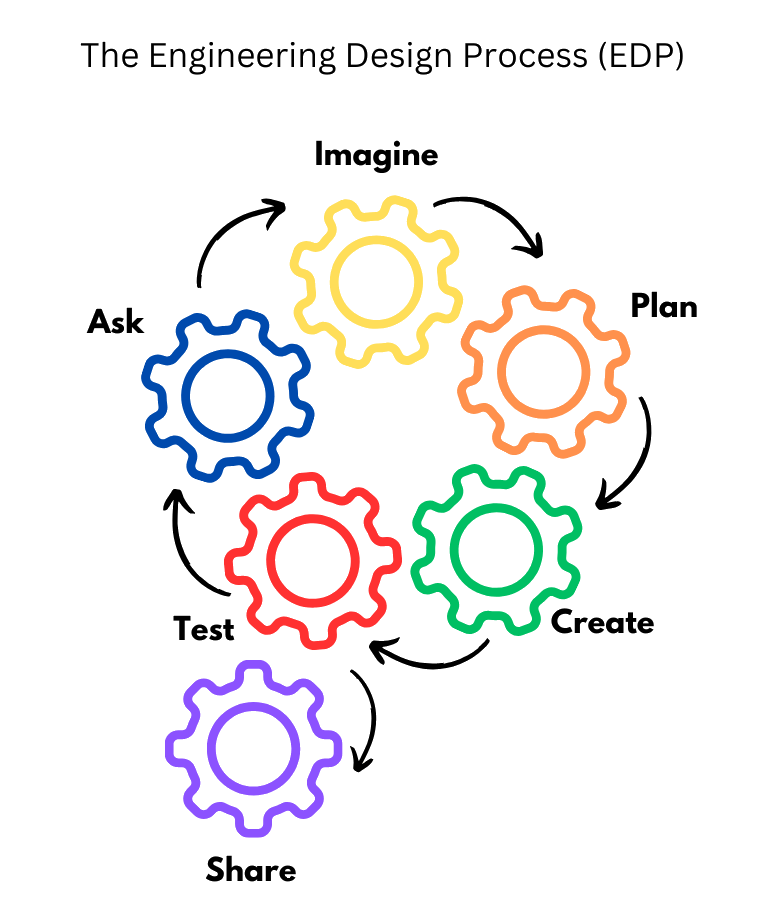
The Engineering Design Process is a structured, iterative approach to problem-solving that helps students tackle complex challenges by guiding them through a series of defined steps (Leo, 2024). Unlike a linear problem-solving method, the EDP encourages continuous refinement, allowing students to learn from their mistakes and improve their solutions over time. Depending on the source, the EDP steps may be broken down slightly different, but I will simplify the process into these six key stages:

This image has an empty alt attribute; its file name is Ask.png
  1. Ask – Identify and define the problem, gather relevant information, and understand any constraints. 
  1. Imagine – Brainstorm possible solutions, encouraging creativity and multiple approaches. 
  1. Plan – Develop a strategy by selecting the best solution and outlining the necessary steps. 
  1. Create – Build a prototype that reflects the design and meets the requirements. 
  1. Test and Improve– Put the prototype into action, iterate and refine the solution based on feedback and testing results. 
  1. Share – Communicate findings, share results, and reflect on the process. 

What Makes the EDP Effective? 

One of the biggest strengths of the EDP is its iterative nature. Instead of following a simple, one-and-done approach, students go through repeated cycles of testing and improvement. This process helps them refine their understanding of the problem, identify weaknesses in their initial designs, and develop stronger solutions (Leo, 2024). It also reinforces resilience, teaching students that setbacks aren’t failures but opportunities for growth. 

Another key feature is its real-world focus. The problems students tackle aren’t just theoretical—they’re grounded in practical contexts. Whether designing an energy-efficient home or improving an everyday product, students engage in meaningful work that connects directly to real-world challenges. 

Finally, the EDP promotes collaboration and creativity. Students work in teams, combining different perspectives to develop and refine their ideas. This teamwork encourages communication, critical thinking, and innovation—skills that are valuable not only in STEM fields but in any career. By using the EDP, students don’t just learn problem-solving techniques; they gain hands-on experience in working through challenges in a way that goes beyond the classroom. 

How the EDP Helps Students Define Problems 

One of the most important aspects of problem-solving is making sure the problem is clearly defined before jumping into solutions. The EDP provides students with a structured way to break down complex issues into manageable components. This foundational step helps students develop skills in critical thinking, creativity, and collaboration, ensuring that students don’t just solve problems but solve the right problems effectively (Moore et al., 2014). 

The first stage of the EDP, Ask, is where students identify the problem, consider constraints, and determine the criteria for success. This stage encourages students to ask essential questions: 

  • What is the problem or need? 
  • Who has the problem or need? 
  • Why is it important to solve? 

From their responses, they can then write a clear problem statement using the “WHO needs WHAT because WHY” format (Engineering Design Process, n.d.). 

For example: 

“Shoppers need a more durable and eco-friendly grocery bag because current options rip easily or require using multiple bags, leading to waste and inconvenience.” 

By explicitly defining the problem and considering its real-life limitations—such as budget, material durability, and environmental impact—students learn to think critically about what makes a solution effective and practical. 

Developing Problem-Solving Skills Through Research and Planning 

Once students have clearly defined the problem, the Imagine and Plan steps guide them through background research and specifying requirements. This stage helps students: 

  • Learn from existing solutions to avoid common mistakes. 
  • Identify key characteristics their design must meet. 
  • Determine whether specific features are both necessary and feasible. 

For example, in designing a reusable shopping bag, students might identify the following requirements: 

  • Handles for easy carrying. 
  • Durability to hold at least five pounds of groceries. 
  • Cost-effective materials, keeping production under five cents per bag. 
  • Eco-friendly components to promote environmental safety. 

By brainstorming multiple solutions and comparing how well each one meets these criteria, students learn to evaluate trade-offs rather than settling for the first idea they think of (The Engineering Design Process: Brainstorm Multiple Solutions, n.d.). They begin to understand that every design has strengths and weaknesses, and the best solutions balance different factors like cost, efficiency, and user needs. 

Bridging the Gap: How Experts Approach Problem Definition 

One of the biggest challenges for students learning the EDP is understanding how much time should be spent defining the problem. Research shows that expert engineers and designers spend significantly more time defining the problem before considering solutions, while students often rush into brainstorming without fully understanding constraints and requirements (Atman et al., 2007). Key differences include: 

  • Experts take time to research user needs, constraints, and technical limitations, while students often rely on limited information and assumptions. 
  • Experts explore multiple potential solutions, weighing trade-offs, while students tend to focus on a single idea too soon. 
  • Experts balance their time across defining the problem, brainstorming solutions, and refining their designs, while students often get stuck on a single phase and struggle to move forward. 

To close this gap, educators should emphasize reflection, research, and iteration, while also providing feedback in problem-solving (Atman et al., 2007). Teaching students to analyze constraints, seek feedback, and explore alternative solutions will help them approach challenges in a way that mirrors real-world problem-solving. 

How the EDP Helps Students Refine Problems 

While defining problems is a critical first step, the true power of the EDP lies in its ability to help students refine their understanding and solutions through iterative design and learning from failure. One of the most valuable lessons from the EDP is that failure isn’t the end of the road, it’s part of the journey. The EDP’s iterative approach teaches students that setbacks aren’t obstacles; they’re opportunities to refine their thinking, improve their designs, and develop persistence. When failure is framed as a normal and necessary step in problem-solving, students build resilience and a willingness to keep going. This can be demonstrated within the Testing and Improving step. 

How Students Respond to Design Failure 

Students respond to failure in different ways. Some see it as a challenge to overcome, while others get discouraged and hesitate to continue. Research shows that how teachers frame failure has a huge impact on how students react (Lottero-Perdue & Parry, 2017). When failure is treated as a normal part of the engineering process, students are more likely to persist, refine their designs, and develop resilience. But if they see failure as a personal shortcoming, they may disengage or struggle to move forward. Teachers who normalize setbacks and provide constructive feedback help students shift into a problem-solving mindset, encouraging them to approach challenges with curiosity and persistence (Lottero-Perdue & Parry, 2017). 

That’s why educators need a range of strategies to help students navigate failure. In some cases, stepping in with probing questions or targeted feedback can help guide them in the right direction (Lottero-Perdue & Parry, 2017). Other times, it’s more effective to step back and let students work through challenges on their own, giving them the space to struggle productively and develop stronger problem-solving skills. 

Encouraging Students to Refine Their Understanding 

The iteration process in the EDP challenges students to re-evaluate their initial ideas, reconsider constraints, and refine their solutions. After reflecting on failures from the Testing and Improving stage, they cycle back to the Ask, Imagine, and Plan stages, where they can redefine questions, research user needs, analyze both their tested solutions and existing alternatives, and redefine key design requirements. This approach mirrors how real-world engineers continuously refine their work. 

One thing to keep in mind is that research also shows experts naturally revisit and refine their designs, while students often struggle with the revision process (Atman et al., 2007). Many students tend to push forward instead of reassessing their work, which can result in incomplete or ineffective solutions. 

To help students develop a more iterative mindset, educators can provide scaffolding such as structured templates or checklists that prompt deeper reflection and refinement (Workosky, 2017). This approach helps break down complex tasks into manageable steps, keeping students on track and focused on solving the problem. It also ensures that the iterative process feels approachable rather than overwhelming. 

Incorporating peer reviews and reflection prompts also encourages students to slow down and critically evaluate their choices. By making iteration a fundamental part of the problem-solving process, students not only enhance their technical solutions but also build essential skills like resilience, adaptability, and critical thinking. 

The Role of Collaboration and Feedback 

Collaboration is another key component of the EDP, as it encourages students to share ideas, challenge assumptions, and refine their solutions together. Working in groups allows students to approach problems from multiple perspectives, leading to more innovative and well-rounded solutions (Moore et al., 2014). This process helps students develop essential communication and teamwork skills, which can also be very applicable to their future careers. 

Beyond simply working together, the EDP requires students to articulate their ideas and justify their design choices. Educators can support this by facilitating discussions where students explain their reasoning, respond to peer questions, and refine their thinking based on group feedback (Workosky, 2017). Through these conversations, students strengthen their ability to analyze problems critically and defend their decisions. 

Feedback plays a crucial role, particularly during the Testing and Improvement stage. Whether it comes from teachers or peers, constructive feedback helps students refine their designs and deepen their understanding of the problem they’re trying to solve. When failure happens—whether a design doesn’t work as expected or falls short in some way—the way it’s framed makes all the difference. Teachers who focus on growth and iteration, rather than just pointing out mistakes, help students build resilience and develop a problem-solving mindset. 

Research continues to emphasize how we talk about failure in the classroom. Using “fail words” intentionally and with context can shift students’ perspectives, moving failure from something to avoid to something that’s simply part of the learning process (Lottero-Perdue & Parry, 2017). When students see setbacks as opportunities to improve, they’re more likely to persist, adapt, and refine their solutions with confidence. 

Integrating the EDP with STEM for Real-World Applications 

As you’ve probably gathered so far from this article, the EDP is most effective when applied to real-world problems. By emphasizing hands-on, experiential learning, the EDP naturally supports STEM education, helping students build critical thinking and problem-solving skills that go beyond the classroom (Workosky, 2017). When students design, build, and test prototypes, they’re not just following a set of steps—they’re actively applying scientific concepts in practical ways. This approach deepens their understanding of STEM principles and equips them with the skills needed to tackle complex, real-world challenges. 

The Role of Experiential Learning 

The EDP’s emphasis on hands-on learning aligns closely with Kolb’s experiential learning model, which emphasizes the importance of connecting abstract concepts to tangible experiences (Long et al., 2020). Research shows that when students engage in hands-on tasks that link STEM concepts to real-world applications, they gain a deeper understanding of the material. One study found that experiential learning not only increased knowledge retention but also boosted students’ intrinsic motivation, satisfaction, and overall interest in STEM subjects (Long et al., 2020). By incorporating experiential tasks into the EDP, educators can create a learning environment where students are more engaged and better equipped to tackle complex tasks. 

Encouraging Interdisciplinary Thinking 

Beyond just building prototypes, the EDP also encourages interdisciplinary thinking by having students integrate concepts from a range of disciplines, including science, technology, engineering, and mathematics. Real-world problems rarely exist in isolation—solving them often requires knowledge from multiple areas. By using the EDP as a framework, students learn to approach problems with a broader perspective, preparing them for the complexity they’ll face in real-world challenges (Moore et al., 2014). 

For instance, designing a sustainable energy solution might require students to apply knowledge of environmental science, electrical engineering, and economics. This interdisciplinary approach not only enhances their problem-solving skills but also prepares them for careers in fields where collaboration across disciplines is essential. 

Conclusion 

The Engineering Design Process is more than just a problem-solving framework—it’s a transformative approach to learning that equips students with the skills and mindset needed to thrive in a rapidly evolving world. By emphasizing iteration, collaboration, and real-world application, the EDP teaches students to define problems clearly, test solutions thoroughly, and refine ideas continuously. This process not only fosters resilience, creativity, and critical thinking but also helps students view setbacks as opportunities for growth rather than failures. 

Through hands-on, interdisciplinary projects, students connect classroom learning to real-world challenges, preparing them for careers in STEM and beyond. The EDP’s focus on experiential learning and interdisciplinary thinking ensures that students are not just passive learners but active problem-solvers who can adapt to new challenges and innovate in evolving situations. 

As educators continue to integrate the EDP into STEM curricula, they have the opportunity to empower students with the skills, confidence, and adaptability needed to contribute to the new innovative ideas and growth within their communities. By cultivating a culture of curiosity, collaboration, and continuous improvement, the EDP not only prepares students for future careers but also empowers them to make a meaningful impact on the world around them. 


Reference 

Atman, C., Adams, R., Cardella, M., Turns, J., Mosborg, S., & Saleem, J. (2007). Engineering Design Processes: A Comparison of Students and Expert Practitioners. Journal of Engineering Education, 96, 359–379. https://doi.org/10.1002/j.2168-9830.2007.tb00945.x 

Engineering Design Process. (n.d.). Science Buddies. Retrieved February 8, 2025, from https://www.sciencebuddies.org/science-fair-projects/engineering-design-process/engineering-design-process-steps 

Leo, G. (2024, January 12). Engineering Design Process Explained. Aria | Online Manufacturing For On-Demand Custom Services. https://www.madearia.com/blog/engineering-design-process-explained/ 

Long, N. T., Yen, N. T. H., & Van Hanh, N. (2020). The Role of Experiential Learning and Engineering Design Process in K-12 STEM Education. International Journal of Education and Practice, 8(4), 720–732. 

Lottero-Perdue, P., & Parry, E. (2017). Elementary Teachers’ Reflections on Design Failures and Use of Fail Words after Teaching Engineering for Two Years. Journal of Pre-College Engineering Education Research (J-PEER), 7(1). https://doi.org/10.7771/2157-9288.1160 

Moore, T., Glancy, A., Tank, K., Kersten, J., Smith, K., & Stohlmann, M. (2014). A Framework for Quality K-12 Engineering Education: Research and Development. Journal of Pre-College Engineering Education Research (J-PEER), 4(1). https://doi.org/10.7771/2157-9288.1069 

The Engineering Design Process: Brainstorm Multiple Solutions. (n.d.) Science Buddies. Retrieved February 8, 2025, from https://www.sciencebuddies.org/science-fair-projects/engineering-design-process/alternative-solutions

Workosky, C. (2017, October 24). The Engineering Design Process: A Middle School Approach | NSTA. NSTA. https://www.nsta.org/blog/engineering-design-process-middle-school-approach