
In today’s digital world, information is everywhere! With content pouring in from social media, websites, academic articles, and everyday blogs, engaging and confronting misinformation and fake news is inevitable. The rise of generative AI in recent years has only accelerated the spread of unverified information, making it easier for users to engage with unreliable content and making it difficult to detect what’s misleading. Social media has become the main platform for sharing news, with algorithms that push attention-grabbing content, and often sharing engaging information without stopping to check if it’s true. This setup, geared for maximum engagement and driven by the desire to “go viral,” is a perfect recipe for misinformation to flourish (Galaz et al., 2023, p. 10). Recent studies show that the top 1% of false news stories can reach between 1,000 and 100,000 people—far outpacing the reach of accurate news (Vosoughi et al., 2018). Even more concerning, between 40% and 60% of adults in developed countries now rely on social media for their news, underscoring the urgent need for media literacy (Galaz et al., 2023, p. 7).
Given these trends, educators must prepare students to critically evaluate online content. Integrating these skills into daily lessons empowers students to recognize credible sources and challenge misinformation. This article explores strategies for embedding content evaluation in the curriculum and highlights tools to support teachers and students in combating misinformation.
The Impact of Misinformation
Psychological Impact
Understanding why people fall for misinformation is crucial, as it affects individuals of all ages and can have significant consequences. Our beliefs are shaped not only by our own reasoning, but also by the perspectives and beliefs of those around us (Galaz et al., 2023, p. 8). Our brains are programmed to seek out information that receives social approval, which means that online likes, comments, and shares often influence what we consider true or false. This social reinforcement creates a feedback loop that can lead us to accept information that either aligns with our existing beliefs and biases or attempts to persuade us to accept sources that may not be credible (Galaz et al., 2023).
People are naturally drawn to content that is both new and emotionally charged, making misinformation particularly enticing. When information is unexpected or packed with strong emotions—especially negative ones—it captures our attention and activates specific brain regions involved in visual processing and attention (Galaz et al., 2023, p. 8). Social media platforms capitalize on this instinct, pushing out more content that speaks to our emotions. The more extreme the emotions, the more likely the content is to be engaged with.
This connection between emotion and sharing hinges on two key concepts: valence and arousal (Urakami et al., 2022). Valence refers to whether an emotion is perceived as positive or negative, while arousal describes the intensity of that emotion. Studies have shown that videos with positive valence and high arousal are shared 30% more often than those that evoke negative emotions or lower levels of arousal (Urakami et al., 2022). This pattern highlights how emotionally engaging content drives interaction and facilitates the spread of misinformation.
As human’s dependent on our social identity, we are motivated by content that enhances our sense of belonging and elevates our status. This can naturally cause us to sustain our social goals by reaching our social standing, or fitting in with a particular group, even at the sacrifice of pursuing the truth. This means that our actions and attention can shift and align with those goals. This psychological tendency makes us vulnerable to misinformation, especially when it resonates with our identity or aligns with social norms (American Psychological Association, 2024). Ultimately, misinformation not only grabs our attention, but also spreads rapidly through social networks, reinforcing biases and shaping beliefs in ways that can lead to unintended consequences.
The Complexities of AI
Adding to the psychological impact, the rise of generative AI has intensified the spread of misinformation, making it challenging to distinguish between real and fabricated content. With major companies like OpenAI, Google, and Microsoft releasing large language models and open-source developers creating models for personal devices, AI tools are now widely accessible (Galaz et al., 2023, p. 17). This access enables users to produce realistic texts, images, and deepfake videos that appear genuine, allowing polished, misleading content to go viral and overwhelm users without specialized tools to verify authenticity.
The speed and volume at which AI can generate content add to the difficulty of filtering misinformation effectively, contributing to three significant challenges for information integrity. First, the sheer volume of information makes it increasingly difficult for users to filter out falsehoods. Second, detecting misinformation becomes complicated when AI can seamlessly blend fact with fiction. Lastly, this continuous flood of misleading content creates a negative emotional impact on users, affecting not only their feelings, but also their trust in information and their perception of others (Urakami et al., 2022). Together, these factors underscore the urgency for enhanced digital literacy to help users navigate the complexities of our AI and social media driven society.
Integrating Online Content Evaluation in the Classroom
As educators, it is our responsibility to prepare students to recognize and counter misinformation, helping them stay grounded in truth and empowering them to make informed decisions. This can be achieved by promoting media literacy, encouraging metacognitive awareness, and incorporating daily practices that sharpen their evaluative skills. By fostering critical thinking and media literacy, we equip students to navigate a media-saturated world with confidence and discernment.
Critical Thinking and Metacognitive Skills
At the heart of tackling misinformation is the need to cultivate critical thinking and metacognitive skills. Beyond analyzing content, students benefit from being in a “metacognitive state”, which is thinking about their own thinking as they process information (Urakami et al., 2022). Research has shown that metacognitive processes can improve a person’s ability to identify false information and respond thoughtfully. By prompting students to actively reflect on how they arrive at conclusions, educators can help them approach information critically, recognizing their biases and assumptions as they evaluate content.
One effective approach to building these skills is through problem-based learning and interactive modules, which have proven successful in enhancing critical thinking (Scheibenzuber et al., 2021). These methods prompt students to engage deeply with real-world scenarios, encouraging them to investigate, question, and analyze information. When used consistently, these activities can help students develop habits that become second nature in their information processing.
Daily Practices for Media Literacy
Integrating content evaluation into daily classroom routines reinforces critical thinking as a skill students can apply beyond school. One simple way to begin is by analyzing real-world media, such as using trending news stories as case studies for fact-checking and source verification. This allows students to compare coverage from various sources, evaluate bias, and identify credibility markers. By analyzing multiple sources covering the same topic, they gain a richer perspective on how different viewpoints emerge and learn the significance of cross-referencing (Black, 2024). This process includes evaluating a range of media types, such as online articles, newspapers, videos, and social media posts, to ensure students are equipped to evaluate information across platforms.
Students should also be encouraged to ask essential questions about the credibility of sources: Who is the author? What are their qualifications? Is there potential bias? Additionally, educators can guide students to examine website features, such as the “About Us” and “Contact Us” sections, as well as publication dates, to verify the source’s validity. To further strengthen these skills, instructors can teach techniques for detecting misleading content, such as analyzing photos for inconsistencies or unnatural proportions—a skill increasingly relevant with AI-generated images (Galaz et al., 2023, p. 18).
By incorporating these evaluative practices into everyday assignments, students become familiar with the steps necessary to critically examine digital content. For example, they may analyze the claims in an article, cross-reference facts, and identify indicators of bias or manipulation, which reinforces their media literacy skills.
Engaging Classroom Discussions
In-class discussions provide a valuable opportunity for students to share their initial thoughts and evaluate them in a broader context. These discussions allow students to engage in metacognitive reflection by comparing their perceptions with those of their peers (Urakami et al., 2022). Regularly addressing topics like “myths vs. facts” in class discussions encourages a questioning attitude and fosters a collaborative approach to understanding complex issues.
Discussing trending news, viral posts, and even controversial issues helps students appreciate diverse viewpoints and consider the motivations behind different media sources (Black, 2024). When students learn to critically assess and articulate their viewpoints, they strengthen their ability to analyze information independently, which is an essential skill for lifelong learning in the digital age.
Gamifying Media Literacy
Video games can also serve as a powerful tool in cultivating critical thinking, media literacy, and motivation for self-learning. Some interactive games focus on helping players distinguish between true and false information, allowing students to practice these skills in a safe, engaging environment (Contreras-Espinosa & Eguia-Gomez, 2023). In fact, research has shown that video games incorporating content such as fake news detection, digital privacy, and media habits can effectively enhance critical thinking skills and help users learn to process and evaluate information.
When used intentionally, video games provide a unique, immersive experience that can increase student engagement. Games such as Influence Inc., Fake It to Make It, Cat Park, Bad News, and BBC iReporter are designed to simulate scenarios that require players to make choices about the reliability of information (Contreras-Espinosa & Eguia-Gomez, 2023). These games present fictional situations where students must evaluate and verify content, offering opportunities to apply their knowledge in identifying misleading information. This interactive environment not only makes learning enjoyable, but also reinforces the skills needed to recognize bias, check sources, and challenge assumptions, all of which are essential for navigating digital content effectively.
Creating a Culture of Informed Evaluation
By integrating these practices into the classroom, educators lay the groundwork for a culture of informed evaluation. Students learn to approach information critically, think about the process of their understanding, and appreciate the importance of accuracy when navigating online. In doing so, they become more resilient against misinformation, able to distinguish credible sources from questionable ones, and better prepared to engage with media responsibly and thoughtfully.
Tools and Frameworks for Detecting and Challenging Misinformation
Educators have a wealth of tools and frameworks at their disposal to help students develop essential skills for evaluating online content critically. As misinformation increases rapidly across social media, equipping students with these resources can empower them to handle the infodemic responsibly, enhancing their critical thinking and metacognitive skills without sacrificing the benefits of digital engagement.
Frameworks for Evaluation
Incorporating structured frameworks provides students with a systematic approach to evaluating information online. These frameworks can be introduced early in the curriculum, reinforcing consistent habits that strengthen students’ ability to question, verify, and critically assess content.
- CRAAP Test
The CRAAP test encourages students to evaluate information based on Currency, Relevance, Authority, Accuracy, and Purpose (Hsu, 2022). This framework helps students assess whether information is reliable, recent, relevant, and free from bias.
- Currency: Students consider when content was published and if it has been updated recently, as well as whether the website remains current and active.
- Relevance: This aspect addresses whether the information is pertinent to the topic and applicable to current events or studies.
- Authority: Examining the source’s credibility, students determine if the author or organization is reputable, with a reliable web domain (.edu, .gov, or .org) indicating a more credible source.
- Accuracy: Students are encouraged to cross-reference facts across multiple sources, watch for typographical errors, and validate content integrity.
- Purpose: Understanding the intent behind information is essential to recognize potential bias. For example, students learn to identify affiliations that might affect content tone, such as advocacy groups versus nonpartisan organizations.
- SIFT Method
The SIFT method—Stop, Investigate the Source, Find Better Coverage, and Trace Claims—helps students approach new information with caution before believing or sharing it (Caulfield, 2021).
- Stop: Before engaging with content, students pause to consider if they recognize the website or source.
- Investigate the Source: Students are guided to explore the source’s credibility, check author backgrounds, and examine affiliations.
- Find Better Coverage: If uncertain, students look for more reliable sources to verify claims. This can be especially valuable when comparing well-known outlets to lesser-known sites.
- Trace Claims and Media: Students learn to track claims back to their origins, allowing them to gain a full understanding of the context behind quotes, images, and video clips that might be cropped or altered.
- IFLA’s Fake News Identification Steps
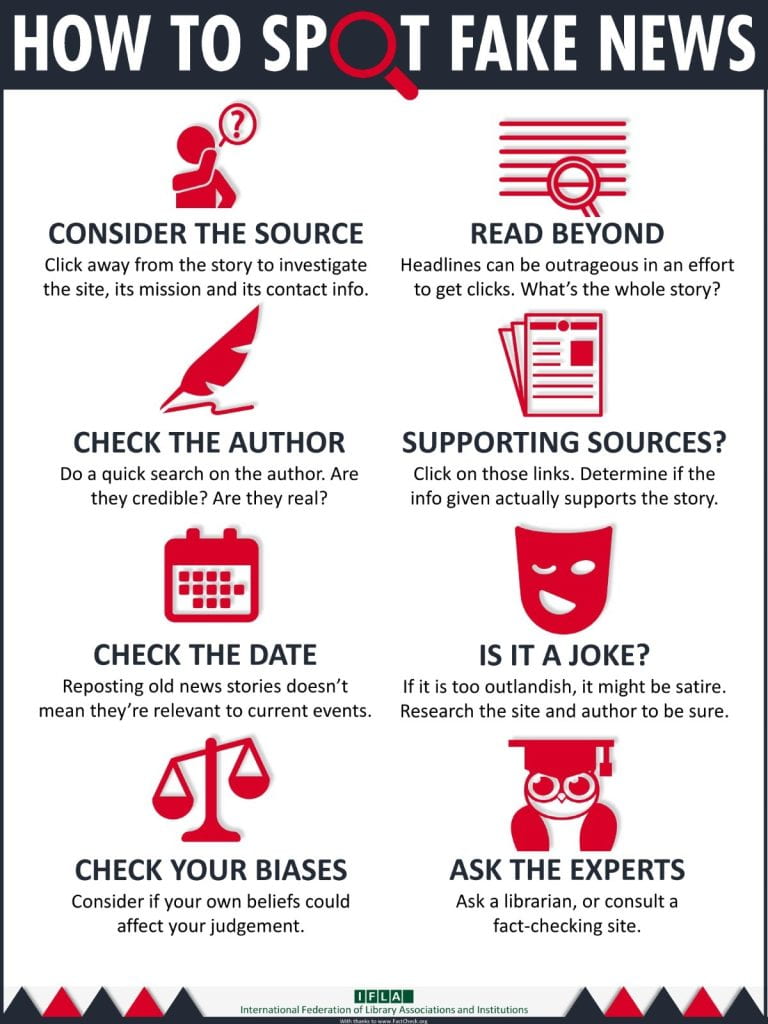
The International Federation of Library Associations (IFLA) provides an infographic outlining steps for spotting fake news, offering educators a concise, visual tool to reinforce the evaluation process. This infographic simplifies verification steps, making it accessible for students to follow in real-time situations (International Federation of Library Associations and Institutions, 2017). Placing the infographic as a poster on the classroom wall is encouraged, allowing students to refer to it whenever needed.
Technology Tools for Fact-Checking and Source Verification
Several digital tools allow educators to integrate hands-on activities for verifying facts and sources. These tools enable students to obtain and practice real-world skills for vetting content on social media, news websites, and other digital platforms.
- Common Sense Media
Common Sense Media offers K-12 lesson plans designed to teach media literacy skills, from evaluating news credibility to understanding social media’s role in shaping public perception. It’s a practical resource that aligns well with frameworks like CRAAP and SIFT.
- Fact-Checking Websites
Various nonpartisan fact-checking websites provide valuable resources for teaching students how to confirm the accuracy of statements, claims, and articles.
This site verifies statements and claims by major U.S. political figures, applying journalistic and academic best practices.
Known for its focus on urban legends, viral claims, and misinformation, Snopes provides clear evidence and source links to help users explore a topic further.
Developed by the News Literacy Project, RumorGuard focuses on helping students recognize and stop misinformation. It offers fact-checked viral rumors and practical tips for evaluating online claims, supporting students’ ability to discern credible information.
This search tool allows students to look up claims and see related fact checks from reliable sources, making it easy to confirm the validity of statements and avoid misinformation.
- Browser Extensions
Web extensions provide real-time analysis of websites, articles, and social media posts, offering quick insights into content credibility and bias as students navigate online.
This Chrome extension uses neural networks to detect possible misinformation without relying on external databases, preserving user privacy while helping students identify potentially false content.
This extension flags articles based on bias levels (e.g., Least Biased, Left Bias, Right Bias) and sources, helping students recognize the political leanings of different news providers.
Conclusion
In today’s increasingly media-driven world, equipping students with the skills to evaluate digital content is more critical than ever. By fostering media literacy, educators can empower students to identify credible information, critically assess sources, and engage thoughtfully with digital content. The tools and frameworks discussed—such as the CRAAP test, SIFT method, and various digital fact-checking resources—provide practical approaches to build these essential skills in the classroom. Ultimately, media literacy not only sharpens students’ ability to recognize misinformation, but also fosters the growth of responsible, informed digital citizens.
Educators play a pivotal role in this process by making digital media evaluation a priority. Teaching these skills supports students in questioning cognitive biases, allowing them to consider alternative viewpoints and challenge pre-existing beliefs (Urakami et al., 2022). By guiding students to engage with differing perspectives, we encourage deeper metacognitive engagement, prompting them to re-evaluate their positions and recognize the influence of emotions on their thought processes.
As misinformation evolves, students of all ages must be equipped to navigate online media responsibly. The skills they develop today will not only protect them from falling prey to false information but will also prepare them for a future where critical discernment is essential. By prioritizing media literacy in education, students can have a lasting impact which will empower them to think independently, make informed decisions, and navigate the digital world with intelligence and responsibility.
References
American Psychological Association. (2024, March 1). How and why does misinformation spread?. American Psychological Association. https://www.apa.org/topics/journalism-facts/how-why-misinformation-spreads
Black, K. (2024, February 26). Teaching information literacy in an age of misinformation . Faculty Focus | Higher Ed Teaching & Learning. https://www.facultyfocus.com/articles/effective-classroom-management/teaching-information-literacy-in-an-age-of-misinformation/
Caulfield, M. (2021, February 15). SIFT (the four moves). Hapgood. https://hapgood.us/2019/06/19/sift-the-four-moves/
Contreras-Espinosa, R. S., & Eguia-Gomez, J. L. (2023). Evaluating video games as tools for education on fake news and misinformation. Computers, 12(9), 188. https://doi.org/10.3390/computers12090188
Galaz, V., Metzler, H., Daume, S., Olsson, A., Lindström, B., & Marklund, A. (2023). AI Could Create a Perfect Storm of Climate Misinformation. https://arxiv.org/pdf/2306.12807
Hsu, Y.-P. (2022, January 6). How to evaluate website content with a quick process. C2C Digital Magazine (fall 2021 / Winter 2022) . https://scalar.usc.edu/works/c2c-digital-magazine-fall-2021–winter-2022/evaluate-website-content
International Federation of Library Associations and Institutions (IFLA). (2017, March 1). How to spot fake news. https://repository.ifla.org/items/c5dbfa34-7d00-47ac-8057-0183a5056438
Scheibenzuber, C., Hofer, S., & Nistor, N. (2021, March 29). Designing for fake news literacy training: A problem-based undergraduate online-course. Computers in Human Behavior. https://www.sciencedirect.com/science/article/pii/S0747563221001199?via%3Dihub
Urakami, J., Kim, Y., Oura, H., & Seaborn, K. (2022). Finding strategies against misinformation in social media: A qualitative study. CHI Conference on Human Factors in Computing Systems Extended Abstracts, 1–7. https://doi.org/10.1145/3491101.3519661
Vosoughi, S., Roy, D., & Aral, S. (2018). The spread of true and false news online. Science, 359(6380), 1146–1151. https://doi.org/10.1126/science.aap9559